


Find out more about Oticon Zeal

Types of hearing loss
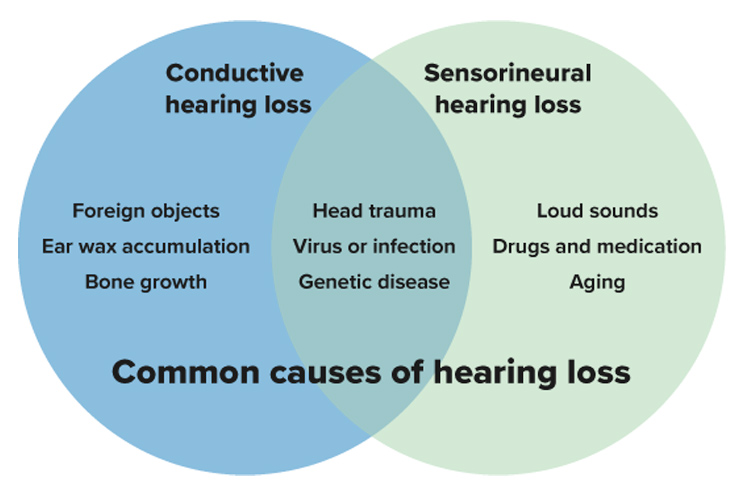
There are three types of hearing loss: sensorineural, conductive, and mixed.
When it comes to treating hearing loss, it's important to understand the differences so you can get a treatment option that works for you.
What are the main types of hearing loss?
The main types of hearing loss are differ based on which part of the ear is damaged:
- Sensorineural hearing loss is caused by damage to the inner ear or hearing nerve. This prevents the damaged area from properly transmitting sound to the brain.
- Conductive hearing loss is caused by damage to the outer and/or middle ear and, in some cases, it is medically treatable.
- Mixed hearing loss is a combination of both sensorineural and conductive hearing loss

Self-assessment: Do I need a hearing test?
Just answer the four questions below to see whether you should consider getting a hearing test.
Question 1 – Around the table
Do you have trouble following conversations when there are four or more people present?
Question 2 – Family and friends
Have your family or friends suggested that you get your hearing tested?
Question 3 – Understanding what others say
Do you ever struggle to understand what others are saying because you cannot hear them properly?
Question 4 – TV or radio
Do you find yourself turning up the TV or radio, even when the volume is loud enough for others?
Your Result:
You would benefit from a hearing test
Your answers indicate that you experience symptoms of hearing loss. We strongly recommend booking a hearing test in one of our clinics.
The result is an indication. An in-person hearing test can determine if you have a hearing loss.
Book your free hearing test:
Your Result:
It seems you’d benefit from a hearing test
Your answers indicate that you experience some symptoms of hearing loss. We recommend booking a hearing test in one of our clinics.
The result is an indication. An in-person hearing test can determine if you have a hearing loss.
Book your free hearing test:
Your Result:
It cannot be determined whether you’d benefit from a hearing test
Your answers do not indicate that you experience symptoms of hearing loss. However, if you experience trouble hearing, we recommend booking a hearing test in one of our clinics.
The result is an indication. An in-person hearing test can determine if you have a hearing loss.
Book your free hearing test:
Sensorineural hearing loss
Sensorineural hearing loss (or sensorineural deafness) is the most common type of hearing loss. For people experiencing sensorineural hearing loss, sounds may be unclear or difficult to hear. Voices in conversation may be distorted, and it might seem like others are mumbling.
Causes of sensorineural hearing loss
- The natural ageing process (age-related hearing loss / presbycusis)
- Excessive exposure to noise (noise-induced hearing loss).
Treating sensorineural hearing loss
This type of hearing loss is often treated with hearing aids.

Conductive hearing loss
Sound travels from the outer/middle ear to the inner ear. But if there's a disruption along its path, this can result in conductive hearing loss.
Causes of conductive hearing loss
This type of hearing loss can also be caused by an obstruction in the ear canal, like ear wax or liquid preventing sound from reaching the eardrum.
Treating conductive hearing loss
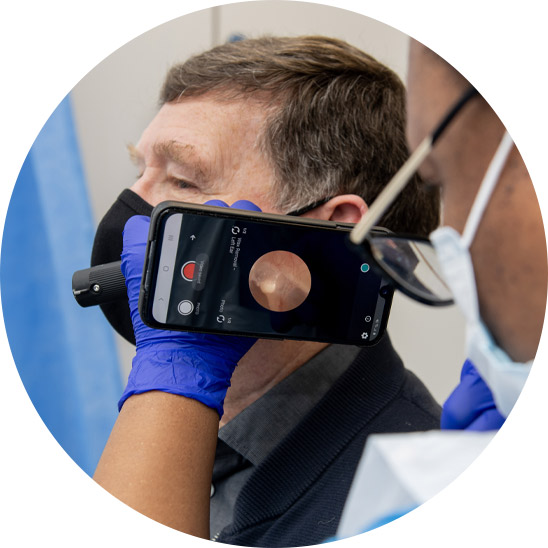
Treatment for conductive hearing loss includes: ear wax removal, and medical and surgical treatments.
Other types of hearing loss
There are other ways to describe hearing loss types. For example:
– High- or low-frequency: Indicates whether you are unable to hear high- or low-pitched sounds (i.e. high-frequency hearing loss means you cannot hear high-pitched sounds)
High-frequency hearing loss
Low-frequency hearing loss
Bilateral hearing loss
Unilateral hearing loss
– Progressive or sudden hearing loss: Indicates whether the hearing loss happens quickly or gradually over time
– Acquired or congenital: Indicates whether your hearing was present at birth or acquired at a later stage in life
Congenital hearing loss
Genetic hearing loss


Tinnitus: ringing in the ears
Tinnitus is a ringing, buzzing, whistling, roaring, hissing sound in the ear that only you can hear. Tinnitus affects about 13% of people in the UK, or 1 in 8. It's often one of the first signs of hearing loss.
The most common cause is exposure to excessive noise, which damages the tiny hair cells in the inner ear. The sound of tinnitus is the result of your brain trying to compensate for the loss of hair cells. The brain misinterprets the reduced signals from the ear, resulting in a perception of sound, or tinnitus.

Grace Sims BSc, Audiologist and Mentor
Grace Sims completed her Bachelor of Science in Audiology at the University of Bristol and has previously worked in the ENT department at Southmead Hospital in Bristol. She joined Hidden Hearing in 2014 and is an audiologist at the Cheltenham clinic. She has been a practice educator for four years and is now a Hidden Hearing mentor.
Last reviewed 2025-07-01
Sources
1. https://www.mayoclinic.org/diseases-conditions/tinnitus/symptoms-causes
2. David M Baguley, Mechanisms of tinnitus, British Medical Bulletin, Volume 63, Issue 1, October 2002, Pages 195–212, https://doi.org/10.1093/bmb/63.1.195
3. https://www.fda.gov/medical-devices/hearing-aids/hearing-loss
4. https://hearinghealthfoundation.org/types-of-hearing-loss